How to Calculate Position Size for Copy Trading
A lot is a unit defined by the broker. Before copying a gold trade, open the symbol specification in both terminals and write down three numbers: contract size, minimum volume and volume step. Matching the symbol name or the number of lots alone does not establish the same position.
Convert lots into units, then back into lots
For the same underlying and unit of measure: receiving lots = source lots × units per source lot × copy multiplier ÷ units per receiving lot. A multiplier of 1 targets the same quantity of the underlying. If you want proportional exposure on comparable accounts in the same currency, a possible starting multiplier is subscriber equity divided by provider equity. That ratio alone says nothing about leverage or available margin.
Open the calculator in its own tab
Three orders that look similar in the terminal
| Source lots × oz/lot | Receiving oz/lot | Exact lots | Outcome at min/step 0.01 |
|---|---|---|---|
| 0.10 × 100 | 100 | 0.10 | 0.10 lots = 10 oz |
| 0.10 × 1 | 100 | 0.001 | below minimum |
| 0.15 × 10 | 100 | 0.015 | 0.01 lots if rounded down |
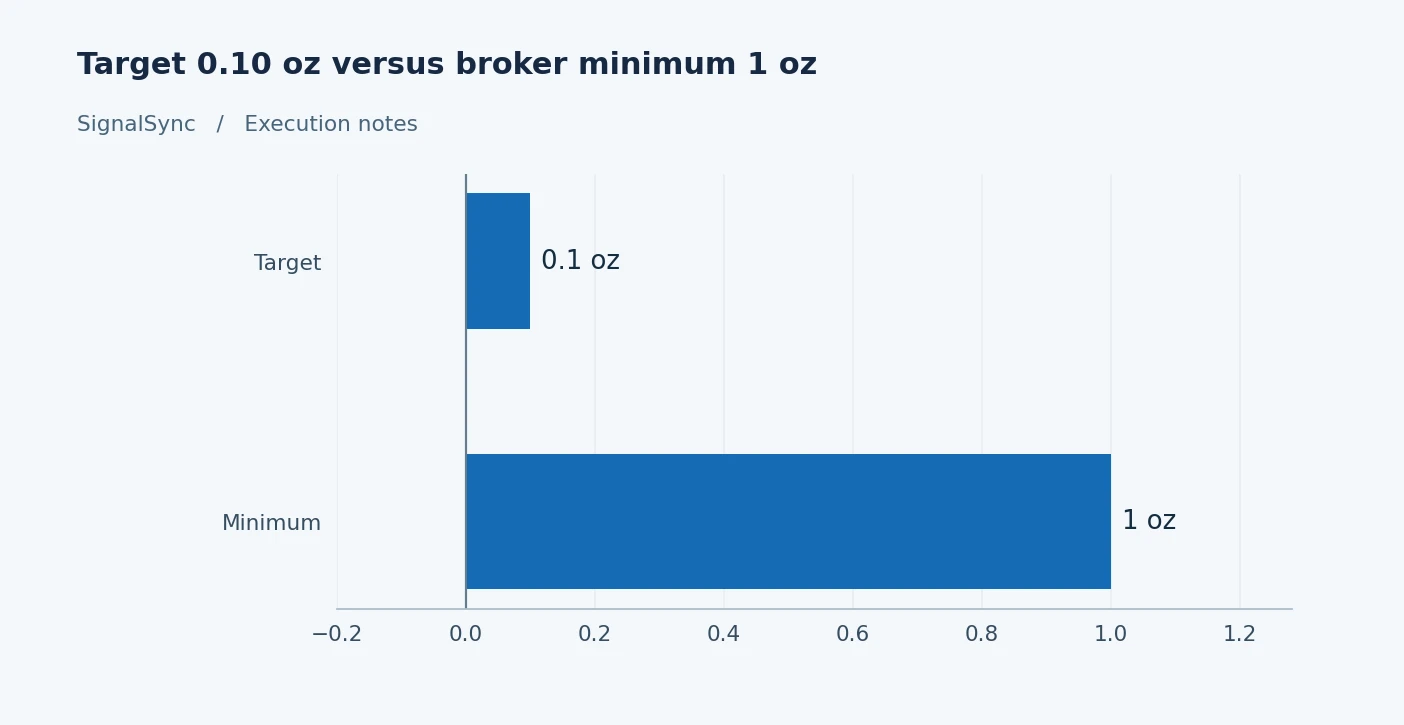
When the calculated lot is too small
In the second row the intended position is 0.10 oz. Rounding to the receiving minimum buys 1 oz, ten times the intended amount. With a 12 USD move against a long position the price loss is 12 USD instead of 1.20 USD before costs. In strict exposure-preserving mode the entry is skipped. Where the copier offers an explicit minimum-lot override, check its exposure limit before enabling it.
The calculator rounds down on the receiving volume grid for an illustration. It does not check your broker’s maximum volume, margin, quote currency, trading session or execution permissions. Check those in the terminal. Without a stop price this calculation gives exposure only. It cannot estimate the maximum loss of a basket that can add positions.
For a trial copy, compare the source and receiving symbol, lots and contract sizes against the deal tickets. A skipped trade should appear in the copier log. Absence from the broker’s trade history by itself does not tell you why an entry was missed.
Sizing from a stop distance
For a linear USD gold contract, a 5 USD stop distance on 100 oz per lot corresponds to 500 USD per lot. A modelled loss budget of 10 USD gives 10 ÷ 500 = 0.02 lots before costs and any adverse fill. A gap can take the realized loss beyond that budget. Compare this stop-based size with the converted provider size before choosing a multiplier.